Connections Lab @ NJIT
2018-2019
The Connections Lab at NJIT is a design and research lab focused on Human-Computer Interaction and Human-Centered Computing — applying design thinking and UX methodologies to explore how emerging technologies can better support human needs, behaviors, and goals.
I worked in the lab as an undergraduate, contributing to the foundational research and early design of a Collaborative Life-Logging system. While graduate students carried the work into publication with CHI and CSCW, my research fed directly into those efforts — literature reviews, exploratory studies, synthesis, and early prototyping that helped establish the direction the lab built on.
Collaborative Life-Logging— what we were exploring
A collaborative life-logging system supports the capture, aggregation, and interpretation of personal data across multiple people and sources — creating richer, shared representations of lived experience. Unlike traditional life-logging focused on individual data streams, this work explored what happens when you combine multiple perspectives: photos, audio, biometric data, geolocation, environmental signals, and more.
The deeper question wasn't technical — it was human. What is worth capturing? And what actually becomes meaningful to revisit? We were designing for memory: not just storage, but how people mentally relive experiences, reconstruct context, and share moments with others over time.
Memory Processes Explored
The system was intended to support multiple types of memory:
Episodic Memory: Enabling users to mentally relive past experiences through rich, contextualized data.
Autobiographical Reminiscing: Supporting recall of facts, context, and meaning associated with events over time.
This required designing beyond simple data storage toward a system that helps users interpret and re-experience moments, individually and with others.
Key Contributions
Conducted foundational research and literature review spanning academic, historical, and speculative sources to map the opportunity space for CLL systems
Led exploratory research into how people capture, recall, and share experiences — interviews (n=10), ethnography (n=3), diary study (n=6)
Synthesized findings into themes and experience frameworks identifying which moments and signals matter most for memory reconstruction
Conducted competitive analysis across adjacent tools — social platforms, fitness trackers, media storage — to surface gaps and opportunities
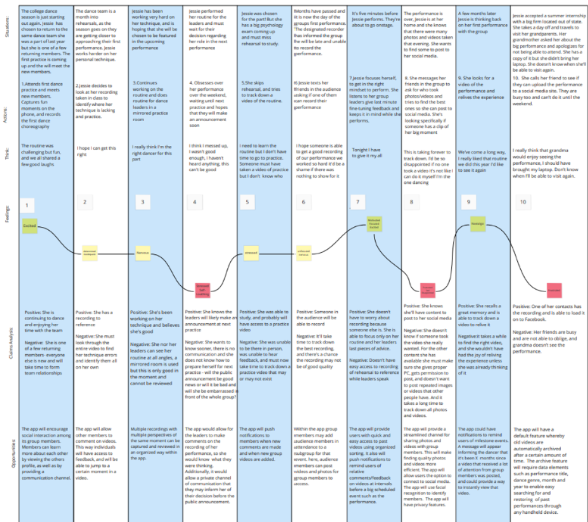
Translated research into journey maps modeling how experiences unfold over time
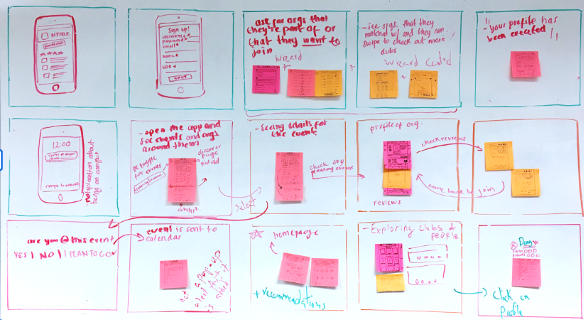
Designed and tested interactive paper prototypes exploring how users navigate multi-source data — usability testing (n=10), 3 iterations
Why this work matters…
This was early career work, but it asked questions I haven't stopped thinking about. Designing for memory and shared experience is genuinely hard — you're not designing for a task, you're designing for how people make meaning. That required sitting with ambiguity, thinking across multiple users and perspectives simultaneously, and resisting the urge to simplify something that was inherently complex.
It's also where I learned what it feels like to go deep on a research problem — to really live inside a question long enough that the interesting stuff starts to surface. The domain was academic, but the instinct it built — stay curious, follow the human thread, don't rush to answers — is one I carry into every project.